
A new strategy and action plan outlines how the region can turn its industrial legacy into a high-road clean energy future.
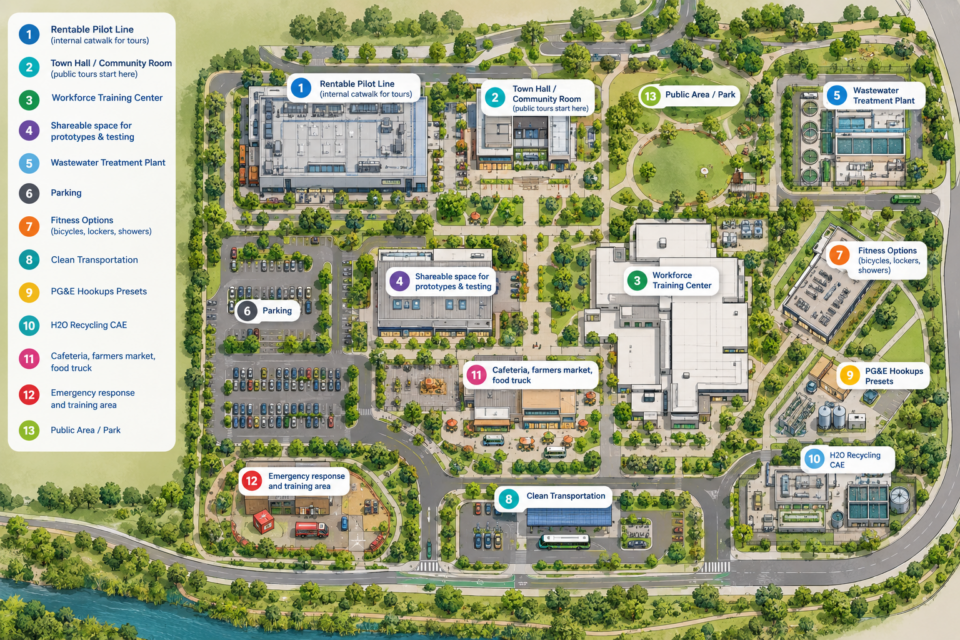
Contra Costa county high road battery innovation hub mockup
California is a world leader in battery innovation. From cutting-edge research at UC Berkeley and Lawrence Berkeley National Laboratory to a thriving startup ecosystem, the state has all the ingredients to lead the global energy transition. Yet too often, the technologies invented here are manufactured somewhere else—taking jobs, supply chains, and long-term economic value with them.
A new report aims to change that. “Contra Costa County: High-Road Battery Innovation Hub Strategy and Action Plan” presents a comprehensive strategy to establish the region as California’s premier destination for midstream battery manufacturing, and to do it in a way that protects workers, communities, and the environment.
Why Contra Costa?
Contra Costa County has been the Bay Area’s industrial heart for more than a century. As California decarbonizes, the region’s skilled workforce, existing industrial infrastructure, and proximity to ports, highways, and world-class research institutions make it uniquely positioned to lead the next generation of advanced manufacturing.
The report, developed by New Energy Nexus and the UC Berkeley Labor Center in collaboration with the Contra Costa High-Road Battery Roundtable, outlines a vision that builds on the region’s strengths rather than replacing them.
What Is a “High-Road” approach?
At its core, the High-Road Battery Innovation Hub is about growing the battery industry as a race to the top, not a race to the bottom. That means:
Quality jobs with strong worker voice and career pathways
Environmental protection and community health safeguards
Durable public benefits from public investment
Shared prosperity for workers, employers, and communities
Rather than asking individual companies to overcome permitting, infrastructure, and workforce barriers alone, the Hub proactively addresses these challenges through built-in partnerships with government, labor, education, and community organizations.
The four pillars of the strategy
- Manufacturing-ready infrastructure: Identify pre-qualified sites, modernize industrial infrastructure, develop shared manufacturing and circular infrastructure, and establish a Manufacturing Concierge to streamline permitting and site selection.
- Competitive manufacturing ecosystem: Create a shared pilot manufacturing center, build innovation and commercialization partnerships, expand access to capital, and promote Contra Costa as a national destination for battery manufacturing.
- High-road workforce system: Develop a battery manufacturing workforce program with apprenticeships, industry-recognized credentials, and job quality standards, while supporting transition pathways for refinery and industrial workers.
- Environmental, worker, and community health: Establish environmental best practices, develop a model for worker health and safety, and build community partnership and accountability through a Community Advisory Group.
The opportunity is now
The global lithium-ion battery market exceeded $150 billion in 2025, driven by electric vehicles, grid-scale storage, data centers, and industrial electrification. While China currently dominates battery manufacturing, the U.S. has a strategic imperative to build domestic supply chains, and California has a unique opportunity to capture the midstream segments where innovation strengths are highest and domestic capacity remains limited.
The report identifies critical materials processing, battery components, and pilot-scale manufacturing as target areas where Contra Costa can fill gaps in the U.S. battery ecosystem.
From insight to action
The strategy was developed through an 8-month collaborative process that brought together manufacturers, labor organizations, community groups, environmental advocates, workforce organizations, educators, and government agencies. The result is a roadmap that is grounded in real employer needs, data-driven analysis, and community input.
The Implementation Roadmap outlines five phases, from research and planning to building, deploying, and scaling, over the next several years.
What’s next?
The Contra Costa High-Road Battery Innovation Hub represents a once-in-a-generation opportunity to build a cleaner, more equitable, and more resilient economy. But it won’t happen automatically. It will require coordinated public and private investment, sustained commitment from partners across sectors, and a shared vision for what advanced manufacturing can look like when it puts workers and communities first.
- For updates related to this report, follow BAHRMI’s LinkedIn here: https://www.linkedin.com/company/bahrmi/
- For questions reach out to Areana Flores at areana.flores@newenergynexus.com
The Contra Costa County: High-Road Battery Innovation Hub Strategy and Action Plan was prepared by Areana Flores of New Energy Nexus. Financial support for convening participants and preparing this report was made possible by the Bay Area High Road Manufacturing Initiative, through a grant from California Jobs First.